 One of the most daunting (but fulfilling) task in the world can be to read the Bible. Often, it can appear to us as disconnected pieces of a jigsaw puzzle and we aren't sure what the picture looks like when the pieces are assembled.
 Sometime ago, I managed to complete reading the entire bible. It took about 1 year & 3 months. (In the midst of living a normal life, not in one sitting...) I managed to do it only after I attended a 'Walk-Thru-The-Bible' conference where I got the Big Picture and saw how all the pieces fits together. That really really helped.
So if you wish to read the whole bible from cover to cover or just start reading it, I've provided a short 'Walkthru', the whole story in a nut..erm...durianshell, to help you start. (It won't take you more than 10 - 15 minutes and I assure you it will be well spent.)

The Bible opens by telling that in the beginning God created the heavens and the earth, and that everything God made was good. Sin enters the story when human beings want to become like God, and disobey God's command by eating fruit that God had told them not to eat. The effects of sin become evident when one man slays his brother out of anger toward God.
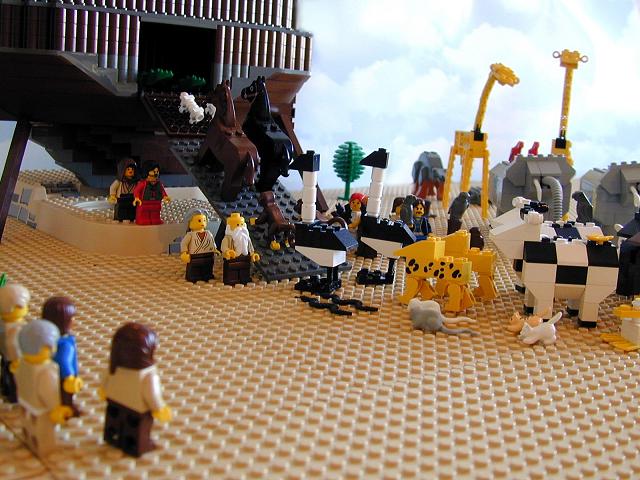 Violence multiplies until God determines to purge the earth by a flood. God commanded Noah to build a boat that could preserve animals from every species from destruction. After the flood, God put the rainbow in the sky to assure people that he would not destroy the earth again. Sin persisted, however, and people sought to make
 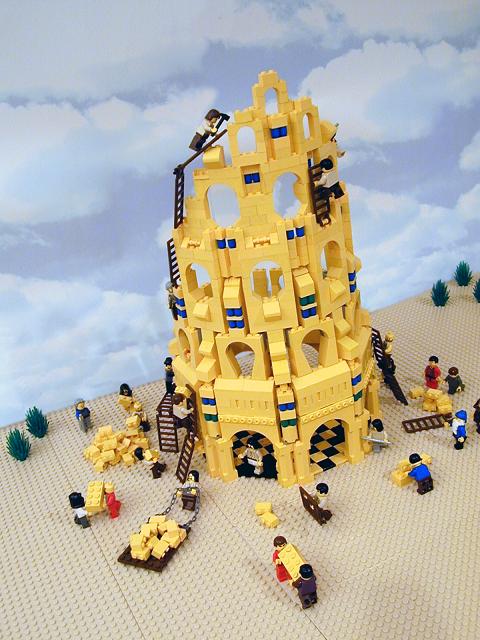 themselves great by building a tower that could reach to heaven. God responded by making people speak different languages, so that they could no longer understand each other, and they scattered over the face of the earth.
 A new phase of the story begins when God calls a man named Abraham, who lived in the area near the Tigris and Euphrates rivers (modern day Iraq and Syria). God told Abraham to go to a land that God would show him., promising that Abraham would have many descendants and that all the nations of the earth would be blessed  through him. Abraham responded to God's call, and with Sarah, his wife, he finally settled in the land of Canaan (modern-day Palestine or Israel). There they tended their flocks and herds. The period was about 2000-1700 B.C.
Abraham and Sarah became old and had no children until God gave them a son, whose name was Isaac. Isaac in turn had two sons, Jacob and Esau. By means of trickery, Jacob obtained a special blessing from his father. When his brother, Esau, became angry, Jacob fled to the home of an uncle, where he married and became wealthy before returning to Canaan. Jacob--whose name was changed to "Israel"--had twelve sons, but because of family rivalry, his son Joseph was sold as a slave and taken to Egypt. There Joseph managed to become a high-ranking official, and when famine drove the rest of the family into Egypt, the brothers became reconciled and settled there permanently.
The descendants of Jacob, who were called Hebrews or "children of Israel," continued to live in Egypt from about 1700 to 1275 B.C. During that time they were enslaved by the Egyptians and forced to make bricks and mortar. A Hebrew named Moses saw an Egyptian beating one of his kinsmen. Moses killed the Egyptian and fled to the desert regions east of Egypt. There he was called by God to return to Egypt and deliver his people from slavery.
 Israel's deliverance from Egypt is commonly known as the "Exodus" and is one of the pivotal events in the Old Testament. The biblical account says that Moses returned to Egypt and told the king that the Hebrew people must be freed. When the king of Egypt refused, the Egyptians were afflicted with various plagues. The water of the Nile River became foul, frogs and insects multiplied, and diseases and darkness made life miserable for the Egyptians. Finally, after the firstborn children and animals of each Egyptian household suddenly died, the Egyptians momentarily relented and the people of Israel fled eastward by night. The Egyptians pursued them, but the Israelites escaped recapture by miraculously crossing a sea while the Egyptian chariots were swept away by the water.

The people of Israel began their new life of freedom by remaining in the desert regions east of Egypt for about forty years, from approximately 1275 to 1235 B.C. The central event of this period was establishing a covenant relationship between God and Israel at Mt. Sinai. The covenant reminded the people that it was God who had brought them "out of the land of Egypt, out of the house of slavery" (Exodus 20:2), and called upon them to honor God alone and reject the deities of other nations. The primary provisions of this covenant, known as the Ten Commandments, became Israel's charter as a nation. After departing from Mt. Sinai, the people gradually moved north and east into what is now the kingdom of Jordan. The generation that escaped out of Egypt, including Moses himself, died out as the people of Israel approached the Jordan River and prepared to enter the land of Canaan once again.
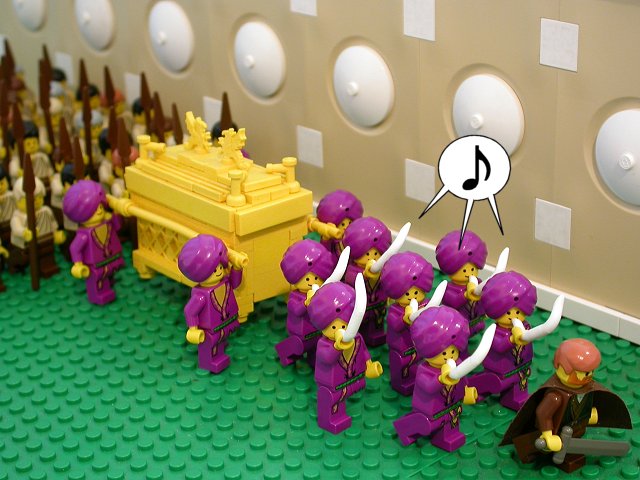 The details of Israel's entry into the land are unclear, but the biblical account suggests that conquest began about 1235 B.C. under the leadership of Joshua. Military victories apparently helped Israel gain possession of part of the land, but the westward movement of the Israelites was halted by the Philistines, who held sizable portions of the country. For generations the twelve tribes of Israel led a precarious existence in Canaan, often subjugated by neighboring peoples until a leader arose to liberate them. One of these leaders or "judges" was Deborah, a prophetess
 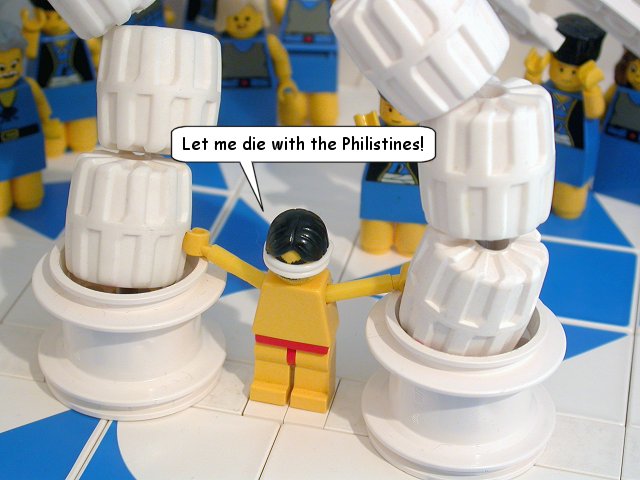 who led the people to victory over the Canaanites. Another judge was the strong man Samson, who fraternized with Philistine women and then avenged himself against Philistine villages when the relationships turned sour.
The continued threat of being dominated by other nations finally led the people of Israel to clamor for a king who could lead them. Samuel, the last of the judges, designated a man named Saul as Israel's first king. Saul was a tall and handsome man. Soon after becoming king, Saul demonstrated his ability by leading the Israelite army to victory. But later Saul was plagued by sharp mood swings and became jealous of the popularity enjoyed by David, a promising young man from Bethlehem, who was a member of his court. David fled for his life and lived as the leader of an outlaw band at the periphery of the country until Saul was wounded in battle and committed suicide.
 David became king about 1000 B.C. and ushered in Israel's golden age. He helped to unify Israel by capturing the city of Jerusalem, which was in the middle of the country, and making it his capital. Under David's leadership a series of successful military campaigns secured Israel's borders against the neighboring peoples. One of David's own sons (Absalom) tried to seize his throne, driving him into temporary exile, but David managed to regain power. Another son named Solomon was designated as David's successor.
Solomon's outstanding achievement was the construction of a temple in Jerusalem, which became the religious as well as the political center of the country. International commerce was expanded, the arts flourished, and an opulent palace was built for the king. To carry out  his building projects, Solomon enslaved some of the non-Israelite peoples within his realm, and to secure his political position, he entered into several foreign alliances. He sealed these pacts by marrying women from the various allied peoples, and he permitted shrines to foreign deities in Jerusalem, even though worship of other gods had traditionally been condemned in Israel.
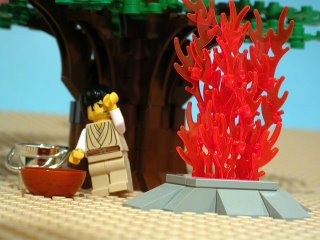
After Solomon died, his son Rehoboam ruled harshly and the kingdom split in two in 922 B.C. (1 Kings 12) The northern part was still called Israel, the southern  part was called Judah, and relations between the two kingdoms shifted between uneasy coexistence and open hostility. The northern kingdom entered into close relations with the nations to the north, and the worship of the god Baal and goddess Astarte became common. The prophet Elijah protested the worship of these deities and challenged the priests of Baal to demonstrate the power of their gods by calling down fire from heaven. When they were unable to do so, Elijah prayed to the God of Israel, fire fell from heaven, and Elijah's followers slaughtered the prophets of Baal (I Kings 18:17-40).
In the eighth century B.C., the prophets Amos and Hosea joined the protest against the idolatrous and unjust practices of the northern kingdom (Israel). Finally, in 721 B.C., the army of Assyria, a powerful nation to the northeast, conquered the northern kingdom of Israel and exiled its leaders.
Meanwhile the southern kingdom of Judah also struggled with issues of idolatry and injustice. The oppressive practices of Judah's leaders were denounced by prophets such as Micah, who came from a village in the foothills, and Isaiah, a resident of Jerusalem. Some reforms were  undertaken by King Hezekiah (2 Kings 18) in the late eighth century B.C., but his successors reverted to patterns of corruption. The prophet Jeremiah, who came from a priestly family, railed against Israel's attraction to foreign cults, some of which included child sacrifice. He warned that if Judah did not repent, it would be devastated like the northern kingdom had been. Major reforms were made in the late seventh century B. C., during the reign of King Josiah. Pagan practices were rejected and worship was centralized at Jerusalem, but in the decades after Josiah's death, the Babylonians brought Judean sovereignty to an end.

The Babylonians destroyed the Jerusalem Temple in 586 B.C.. Judah's leading citizens were exiled to Babylonia far to the northeast, leaving only a remnant in the country. The Babylonian exile was one of the great crises in Israel's history. People questioned how God could permit the brutal destruction of Jerusalem and the loss of Israel's homeland. Nevertheless, the prophet Ezekiel told the exiles that even though Israel seemed as lifeless as a field of dry bones, God would revitalize the people and take them home again (Ezekiel 37:1-14).
 A turning point came when Cyrus, king of Persia, conquered Babylonia. In 538 B.C., Cyrus declared that the exiles, now known as Judeans or Jews, could return to their country. Some of the exiles chose to remain in Babylonia, but others returned and began the slow task of reconstruction. Urged on by prophets such as Haggai and Zechariah, whose writings appear in the Old Testament, the people eventually established a new temple and rebuilt Jerusalem. The scribes Ezra and Nehemiah called for
 renewed commitment to the laws and traditions of Israel that were being assembled into the form in which we now have them in the Pentateuch (Genesis, Exodus, Leviticus, Numbers, and Deuteronomy). Together, the temple and the law became the two institutions that gave the people their distinct identity while living under Persian domination.
A significant change began when Alexander the Great swept down from Macedonia and Greece to conquer Palestine in 330 B.C. Alexander envisioned a grand world city in which people would not belong primarily to a given tribe or local community, but to the Greek  Empire. The new vision of one world city differed significantly from the conviction that Israel was God's chosen people. Some of the Jewish people liked the new vision and began adopting Greek customs, but others rebelled and insisted that to do so would be to commit apostasy. The governor of that region tried to suppress the revolt by forbidding observance of Israel's law and by turning the Jerusalem temple into a shrine that he dedicated to Zeus in 167 B.C.
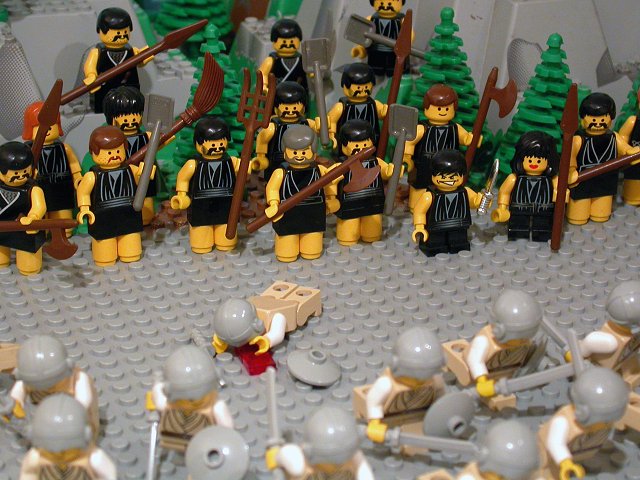 A group of Jews led by Judah Maccabee successfully recaptured the temple and purified it in 164 B.C. Soon they regained control of the country and set up their own government, the first independent government since Jerusalem had been conquered by the Babylonians four hundred years earlier. This Jewish kingdom endured for a century.
 In 63 B.C. a Roman general conquered Jerusalem and brought Jewish independence to an end. The Romans eventually designated a man named Herod to rule Palestine. An ambitious and masterful politician, Herod accommodated devout Jews by transforming the modest
 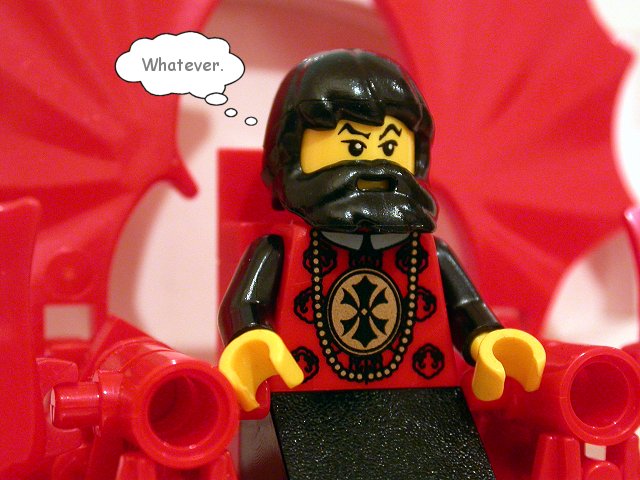 Jerusalem temple that had been rebuilt after the exile into an imposing structure of gleaming white limestone adorned with gold.
New Testament
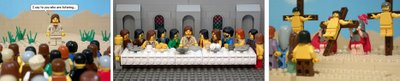
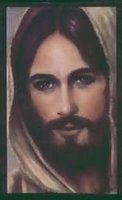
It was into this unsettled world that Jesus was born. He taught and examplified to all who listened, the way to live a life that pleases God. He went everywhere, preaching about God's Kingdom and healing the sick. He was then crucfied and died to save all of humanity from their sins. And on the third day, He rose to life. 40 days later, He acended into Heaven and sent the Holy Spirit to His Disciples. And on that day, the Church was born.
 Belief that Jesus would return in a short time gave great urgency to the spread of the good news about him. Enlivened by the Spirit of God, they gathered in homes for prayer and fellowship. Many of the religious authorities opposed the new faith and some of Jesus' followers were imprisoned or killed. Others fled to places outside Judea, where the gospel message was received by Samaritans and Greeks as well as by Jews.
 One of the Jewish leaders who persecuted the emerging church was Saul of Tarsus, better known to us as the apostle Paul. Near the city of Damascus he encountered the risen Christ, who called him to be a proclaimer of, rather than an adversary of, the gospel. Paul set out on a career as a missionary, proclaiming the message of Jesus Christ in the cities of what are now Syria, Turkey, and Greece. His preaching centered on a vivid proclamation of Jesus the crucified Messiah, a message that
  kindled faith in the hearts of many hearers who were stirred by the power of the Holy Spirit. Paul became a leading figure in the mission to non-Jewish people, who were known as Gentiles.
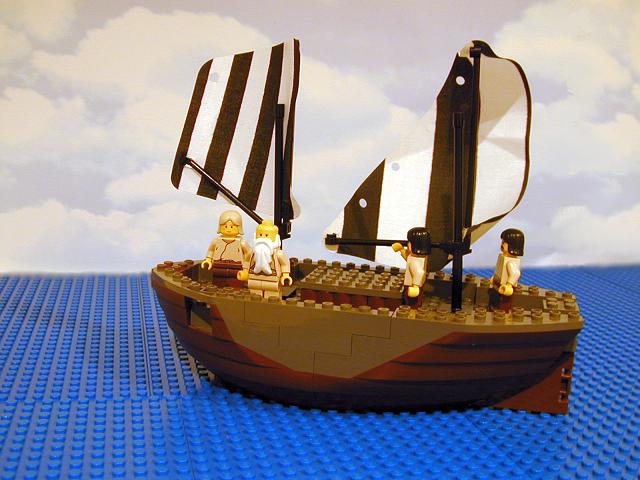 Paul was imprisoned because of his missionary activities. The book of Acts tells us that Paul eventually was taken to Rome as a prisoner. Later Christian writings also say he was executed there in A.D. 62, during the persecutions that took place under Nero.
The last book in the New Testament is Revelation, which is a letter written in about A.D. 95 by the Apostle John. The book calls Christians to renewed faith in God and in Jesus Christ, confident that God will triumph over evil. The final chapters bring the Biblical story back to its beginning. In the beginning, people were barred from the tree of life because of sin (Genesis 3:22-24), but in the end the redeemed come to the tree of life in God's new Jerusalem (Revelation 22:2).
And the rest, as they say, is His-tory.

Postscript:
I (Leo) want to testify that upon reading the Bible from cover to cover, my Faith and Spiritual life grew so much and went to the next level. The bible itself says "Faith Comes by hearing and hearing by the Word of God." Its true. As I read the bible into my spirit, it grew stonger and stronger.
Try it.
It will be the best thing you will ever do.
Do drop a comment to tell us what you think!